"He built a wall around language, then spent a decade tearing it down."
In 1918, a twenty-nine-year-old Austrian prisoner of war finished a hundred-page manuscript he believed closed every real problem of philosophy. Ludwig Wittgenstein had written it in fragments between duties on the Eastern Front and in captivity in Italy. Published in 1921 as the Tractatus Logico-Philosophicus, its final line reads like a warning: about ethics, God, and the meaning of a life, you should say nothing at all — not because those things are fake, but because language, properly understood, cannot reach them. Two decades later, the same man had quietly taken that book apart, sentence by sentence, and built something close to its opposite. Neither theory was a mistake he disowned. Both were serious, worked-out answers to one question: what can words actually do, and where do they stop working?
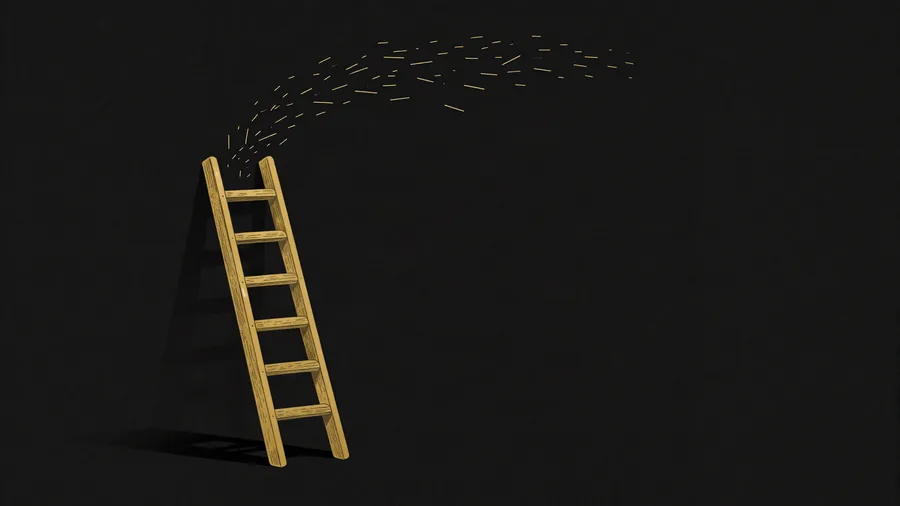
The Tractatus proposes what is usually called the picture theory of language. A meaningful sentence, Wittgenstein argued, works like a picture: it shares a logical structure with the fact it describes, the way a model built from toy figures can share a structure with a real event without looking like it. The world, in the book’s famous opening line, is not a collection of things but everything that is the case — the totality of facts, built from objects arranged in specific ways. A sentence has sense only if it could, in principle, picture one of those possible arrangements — checkable against the world, able to come out true or false. That machine has a sharp edge, and the edge is the point of the book. If a sentence cannot picture a possible fact, it isn’t false — it’s meaningless in a strict technical sense, however grammatical it sounds. Ethics cannot picture a fact. Neither can aesthetics, nor most traditional metaphysics — nor, Wittgenstein admitted, large parts of the Tractatus itself. In its closing proposition 6.54, he told readers to use the book as a ladder and then throw it away once they’d climbed through it. The final line, proposition 7, follows: “Whereof one cannot speak, thereof one must be silent.”
For a decade, Wittgenstein treated that as the last word — he left philosophy, taught primary school in rural Austria, worked as a monastery gardener. Then, back at Cambridge in 1929, he found cracks in his own machine. The picture theory assumed all meaningful sentences share one hidden logical structure. But ordinary language doesn’t work that way: giving an order, telling a joke, praying, cursing, naming a color for a child — none of that needs to picture a fact to work perfectly well. Over the next two decades he built a second theory, later published as Philosophical Investigations. He called its units language games — activities with their own internal rules, the way chess has rules that don’t apply to tag. Its most quoted line states the reversal directly: “The meaning of a word is its use in the language.” He illustrated it with the word “game” itself: look for one feature common to board games, card games, and the Olympic Games, and you won’t find it — only, as he put it, “a complicated network of similarities overlapping and criss-crossing,” a pattern he named family resemblance. No single essence holds the category together, just overlapping threads of likeness.
Early Wittgenstein drew one hard wall around what language can say. Late Wittgenstein replaced it with a sprawling toolbox of different games, held together by family resemblance rather than a shared essence, where meaning comes from use within a shared form of life rather than from matching a fact. The boundary of language didn’t just move — the idea of a single boundary dissolved. The idea’s practical residue outlived the philosophy seminar: the later Wittgenstein’s use-based theory of meaning shaped ordinary language philosophy, particularly at Oxford in the following decades, and the underlying habit travels past academic philosophy entirely. Most confusion in an ordinary conversation, Wittgenstein came to believe, isn’t people disagreeing about facts — it’s people playing different language games without noticing, and mistaking the mismatch for a disagreement about the world.
None of this is quite as settled as a two-act story suggests. Philosophical Investigations was never published in Wittgenstein’s lifetime — he had the first part essentially finished by 1946 but kept revising it, died in 1951, and it reached print in 1953, edited from his manuscripts by Elizabeth Anscombe and Rush Rhees. Scholars broadly agree a real, documented shift occurred between the early and late Wittgenstein, close to a reversal of his central theory of meaning, but how sharp that break really was stays debated — specialists sometimes call the years right after his 1929 return to Cambridge the “middle Wittgenstein,” a transitional stretch where pieces of both pictures overlap in his notebooks. A second, separate debate concerns how to read the Tractatus itself: on one reading, the book sincerely believed its own final propositions were meaningless by its own strict rule and asked readers to discard them anyway; a rival “resolute” reading argues Wittgenstein meant something subtler by that self-cancelling gesture. That interpretive dispute has run for decades without full agreement.