Philosophy · Philosophy of science
Why two scientists can look at the same fire and see different worlds
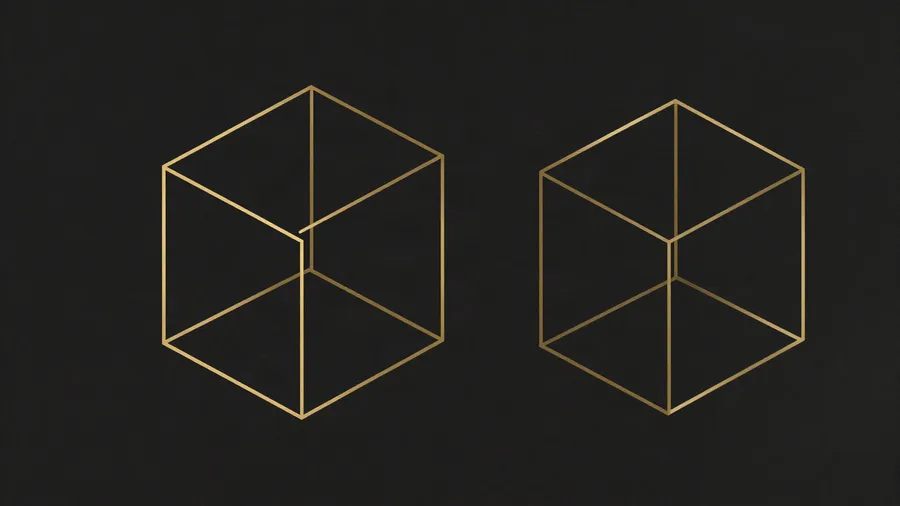
"Science doesn't accumulate — it breaks and starts over."
Two chemists, a hundred years apart, both stare at a burning piece of metal. One sees a mysterious substance — phlogiston — leaving the metal as it burns, something all flammable things supposedly contain and release when they catch fire. The other looks at the same flame and sees the metal pulling something out of the air, gaining weight instead of losing it. Same fire, same metal, same eyes, more or less — and yet the two are not merely disagreeing about a theory. In a real sense, they are looking at two different worlds.
Explaining how that’s possible, how the facts can stay the same while the world built out of them changes underneath scientists’ feet, was the project of historian Thomas Kuhn. He came to it sideways: trained as a physicist, doctorate in the late 1940s, before drifting into the history of science. Teaching old scientific texts to undergraduates, he had a shock reading Aristotle’s physics — Aristotle wasn’t a bad, confused version of Newton fumbling toward the right answer. His physics was a coherent, workable system with its own logic and its own definitions of motion and cause, one that made sense entirely on its own terms. It wasn’t primitive science. It was different science. That observation became the seed of The Structure of Scientific Revolutions, published by the University of Chicago Press in 1962, and the word Kuhn coined there to explain it — paradigm — changed how almost everyone talks about how knowledge moves forward.
He used the word in two senses that matter most. First, a paradigm is a shared way of seeing a whole field: the theories a community takes for granted, the instruments it trusts, the questions it considers worth asking. Second, more concretely, a paradigm is an exemplar — a specific, celebrated piece of past work that a generation of scientists trains on and then uses as the model for solving new problems, the way a chemistry student learns what counts as a proper problem by working through solved examples rather than by memorizing definitions. Most of science, in this picture, is what Kuhn called normal science: puzzle-solving. Not testing whether the paradigm itself is true, but trusting it and using it to mop up the details — measuring a constant more precisely, fitting an anomaly into the existing framework. It’s the grinding, necessary craft work of a mature field.
But anomalies don’t always cooperate. Most get folded into the paradigm and patched over. Occasionally one refuses — it keeps resisting, other researchers keep hitting it, and it starts eating at the community’s confidence rather than its patience. Kuhn called this a crisis, a period when scientists start questioning the paradigm itself rather than their own competence at using it. Out of a deep enough crisis comes a scientific revolution: not an update to the old paradigm, but its replacement, built on different assumptions. His favorite illustration was eighteenth-century chemistry’s phlogiston theory of combustion, patched for decades against the awkward fact that some burned metals came out heavier than they went in, until Antoine Lavoisier reframed burning as a gas — oxygen — combining with a material rather than something leaving it. The weight gain stopped being an embarrassing exception and became exactly what the new theory predicted. Kuhn also pointed to the shift from an Earth-centered to a Sun-centered cosmos, from Copernicus through Kepler and Galileo, as an equally clean case of one entire framework being replaced by another. And here he made his most contested claim: that paradigms can be, in his word, incommensurable — there is no neutral, paradigm-free yardstick to measure the old one against the new one. Different paradigms can disagree about what counts as a good explanation in the first place. What a scientist perceives, not just concludes, can shift with the paradigm, the way the same lines in a Gestalt image can be seen as a duck or a rabbit. Sometimes the words themselves change meaning across a revolution — “mass” in Newton’s physics isn’t quite the same concept as “mass” in Einstein’s, even though both theories use the identical word.
What Kuhn established, and what is now broadly accepted history, is that science doesn’t move in one smooth motion toward the truth. It alternates between long stretches of normal science and rare, disruptive revolutions that replace the framework itself — a pattern documented across real episodes like phlogiston chemistry and the Copernican shift, and one that has held up across decades of further historical study. The word he coined for the disruptive part escaped the history-of-science seminar entirely and now gets applied to a new phone or a marketing strategy — a much sharper, much stranger idea borrowed for far smaller occasions than the one it was built for.
Kuhn’s more radical claim, incommensurability, remains genuinely debated. Critics accused him of relativism: if there’s no paradigm-free ruler to measure competing frameworks by, doesn’t truth become whatever the winning community happens to agree on, with no real sense in which science gets closer to reality? Kuhn pushed back against that reading. He argued theory choice isn’t arbitrary, just not governed by simple, mechanical rules — much as recognizing a familiar face isn’t done by consciously checking a list of measurements, yet is done reliably. He also maintained that later paradigms really do solve more puzzles, more precisely, than earlier ones — a meaningful notion of progress, just not a straight-line march toward one final, true theory. Even his central term became a sore point: philosopher Margaret Masterman pointed out that “paradigm” was used in something like two dozen different senses across the book’s original text, and Kuhn took the criticism seriously enough to write a postscript for the second edition narrowing it down, leaning most heavily on the “exemplar” sense as the core idea. The very term that escaped into everyday language as “paradigm shift” was, by its own author’s later admission, not as crisply defined the first time around as its cultural success might suggest.