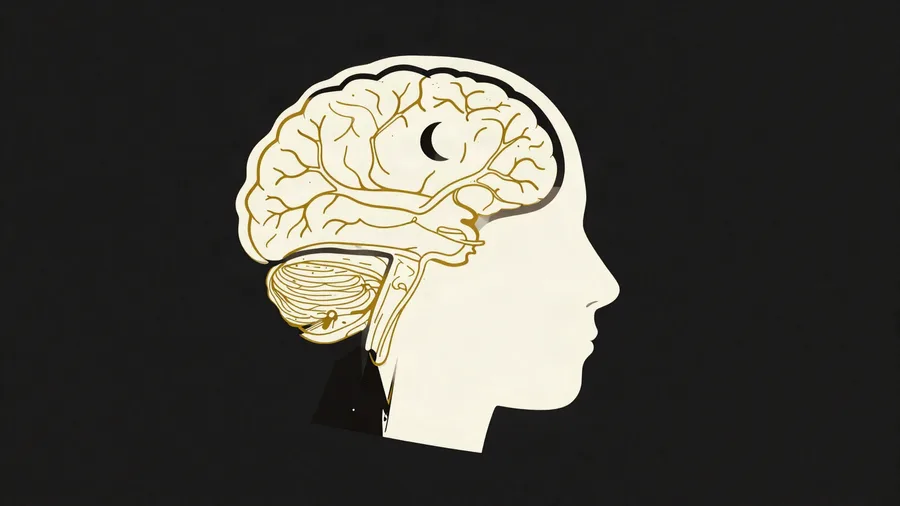
"The brain's cleaning crew keeps its own hours, lights or no lights."
Somewhere behind your eyes, right now, fluid is moving — not blood, something clearer, seeping along the outside of your brain’s blood vessels and washing through the spaces between its cells, carrying away the metabolic trash a day of thinking leaves behind. This is the glymphatic system, and it’s long been known to run harder while you sleep, which fit the tidy story that sleep is when the brain cleans itself. A study out of the University of Rochester and the University of Copenhagen suggests the real story is more specific, and stranger: the cleaning isn’t simply tied to sleep. It runs on its own internal clock, one that keeps ticking whether the lights are on or not.
To find that out, the researchers injected a fluorescent tracer into the cerebrospinal fluid of mice and measured how much of it reached the brain tissue at different points across the day. Fluid influx ran roughly 50% higher during the animals’ rest phase than during their active phase, and a second tracer confirmed the mirror image on the way out — more waste cleared during rest, too. Chasing the mechanism led to aquaporin-4, a water channel on the brain’s support cells that sat more precisely positioned, or “polarized,” during rest than during activity; mice bred without that channel lost the day-night difference entirely. The most convincing piece came from mice kept in constant light for ten days, with no day-night cue of any kind. The rhythm kept running anyway — the signature of a genuine internal clock, not just a reaction to light or to sleep itself.
That reframes brain cleaning as a scheduling problem rather than only a sleep problem: when you rest, relative to your body’s own clock, may matter almost as much as how long you rest. The authors point to shift work as a real-world echo of this — chronic misalignment between sleep and the internal clock is linked to higher rates of neurodegenerative disease, and the plausible reason, they suggest, is that the very system meant to clear amyloid-beta, the protein implicated in Alzheimer’s, ends up running out of sync with when it’s actually needed.
None of this is settled science about you, though, and the authors are direct about why. This is a mouse study, and the clearest version of the rhythm showed up under anesthesia — in awake mice, the day-night difference wasn’t nearly as clean. Whether the same clock-driven cleaning happens in the human brain is still unknown, the tracers used stand in for natural waste without being identical to it, and the constant-light experiment ran for only ten days. What’s here is a well-supported finding in mice, and a genuinely strong reason to go looking for the same mechanism in people — not yet a proven fact about how your own sleep works.